
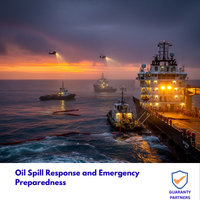
Oil Spill Response and Emergency Preparedness
Course Overview
• Understand the environmental, safety, and operational impacts of oil spills
• Equip participants with strategies and procedures for effective spill response
• Strengthen emergency preparedness, risk mitigation, and incident management
• Foster a culture of safety, compliance, and environmental stewardship
Training Format:In-class, Virtual, In-house
Location:Lagos, Accra, Nairobi, Kigali
Language:English, French
Nigeria Price:
₦360000
Int'l., (Nigeria) Price:
$1000
Ghana Price:
$4000
Kenya Price:
$5500
Rwanda Price:
$6000
Nigeria Price:₦360000
Int'l., (Nigeria) Price:
$1000
Ghana Price:
$4000
Kenya Price:
$4000
Rwanda Price:
$4000
Nigeria Price: ₦360000
Int'l., (Nigeria) Price:
$1000
Ghana Price: $4000
Kenya Price: $4000
Rwanda Price: $4000
Introduction to Oil Spill Risks
• Types, causes, and sources of oil spills
• Environmental and operational consequences of oil spills
• Legal and regulatory frameworks for oil spill management
• Understanding organizational responsibilities and stakeholder roles
Emergency Preparedness Planning
• Principles of emergency response planning
• Developing contingency and response plans
• Risk assessment and scenario analysis for oil spills
• Coordination with internal teams, authorities, and stakeholders
Oil Spill Response Techniques
• Containment and recovery methods (booms, skimmers, absorbents)
• Chemical dispersants and controlled burning
• Shoreline and coastal protection strategies
• Case studies of successful oil spill response operations
Command, Control, and Communication
• Incident command system (ICS) for oil spill response
• Roles and responsibilities of response teams
• Effective communication during emergencies
• Coordination with regulatory bodies and external partners
Health, Safety, and Environmental Protection
• Personal protective equipment (PPE) and safety protocols
• Minimizing environmental impact during response operations
• Hazard identification and risk mitigation
• Post-incident environmental monitoring and reporting
Training, Simulation, and Continuous Improvement
• Conducting drills and emergency simulations
• Evaluating response effectiveness and lessons learned
• Continuous improvement of preparedness and response plans
• Building a resilient and responsive organizational culture
1ST BATCH: Tuesday, March 3, 2026 — Friday, March 6, 2026.
2ND BATCH: Tuesday, July 7, 2026 — Friday, July 10, 2026.
3RD BATCH: Tuesday, November 3, 2026 — Friday, November 6, 2026.
The training methodology integrates lectures, interactive discussions, collaborative group exercises, and
illustrative examples. Participants will acquire a blend of theoretical insights and hands-on practical
experience, emphasizing the application of learned techniques. This approach ensures that attendees return
to their professional environments equipped with both the competence and self-assurance to effectively
implement the acquired skills in their responsibilities.