
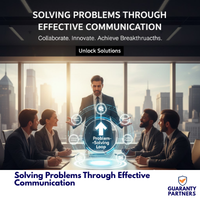
Solving Problems Through Effective Communication
Course Overview
This course will feature:
• The psychology of personality and how this influences the solutions we select ensuring greater understanding of the behavioural traits of yourself and others
• The application of whole brain thinking to the problem solving process in order to balance the logical and creative dimensions of problem solving
• Assessing personal creativity and challenge the mental blocks that limit our thinking
• Practical solutions to work related issues through Neuro Linguistic Programming, Emotional Intelligence and psychometric profiling
• Advanced communication and motivation models essential to modern day business units that will greatly enhanced leadership skills
Training Format:In-class, Virtual, In-house
Location:Lagos, Accra, Nairobi, Kigali
Language:French
Nigeria Price:
₦300000
Int'l., (Nigeria) Price:
$1000
Ghana Price:
$4000
Kenya Price:
$5500
Rwanda Price:
$6000
Nigeria Price:₦300000
Int'l., (Nigeria) Price:
$1000
Ghana Price:
$4000
Kenya Price:
$4000
Rwanda Price:
$4000
Nigeria Price: ₦300000
Int'l., (Nigeria) Price:
$1000
Ghana Price: $4000
Kenya Price: $4000
Rwanda Price: $4000
How to Build Lasting Rapport
The art of building lasting rapport
How to identify behavioural traits and react to them
How to modify your own behaviour to match other’s
Sharpen your senses to the signals others are sending you
Connect with colleagues and clients at a level that creates deeper trust and commitment
Read body language in order to understand how others are thinking and responding to you
Empathy: The Ability to Understand Situations from Another’s Perspective
Review how to sharpen your senses to the signals others are sending you
Communicating first impressions – the secrets of body language
How we communicate
Filters to communication
Learning Styles
Modelling: how others do things
The Psychology of Problem Solving and Decision Making
Introduction: Why study problem solving and decision making
A synopsis of psychological thought
Values, Problem Solving and Bias in Decision Making
Psychological type and Lateral Thinking for Problem Solving
Psychometric assessment on your problem-solving preferences
Using a team approach to encourage structured and lateral thinking
Problem Solving, the Cognitive Process and Whole Brain Thinking
Problem solving: the highest order cognitive process
Split brain theory to make informed and balanced decisions
Developing openness to new ideas in making decisions
The model of creative problem solving
Lessons in facing the unexpected events
Decision Making and the Management of Change
Creating Continuous Improvement in the Workplace
Encouraging creative problem solving for continuous improvement
Appreciative Enquiry and a focus on positive dialogues
Solution focus methodology: a radical transformational approach to solving problems
Diagnostic tools for organisational improvement
Using techniques to innovate and improve process and product
The Disney Creative Thinking Strategy
Building Creative Capability in Self and Removing Mental Block
‘How creative am I’? Challenging self-imposed assumptions
Thinking outside the box and ‘Imagineering’: current examples from technology
‘Curiosita’: using the multiple intelligences of Leonardo da Vinci
A model for organisational innovation
Organisational culture and its influence on the creative organisation
Creative leadership in times of crisis: the role of emotional intelligence in decision making
1ST BATCH: Monday, March 16, 2026 — Thursday, March 19, 2026.
2ND BATCH: Tuesday, July 14, 2026 — Friday, July 17, 2026.
3RD BATCH: Tuesday, November 10, 2026 — Friday, November 13, 2026.
The training methodology integrates lectures, interactive discussions, collaborative group exercises, and
illustrative examples. Participants will acquire a blend of theoretical insights and hands-on practical
experience, emphasizing the application of learned techniques. This approach ensures that attendees return
to their professional environments equipped with both the competence and self-assurance to effectively
implement the acquired skills in their responsibilities.