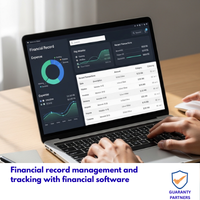
Financial record management and tracking with financial software
Course Overview
• Understand the importance of accurate financial record management for organizational success.
• Learn to navigate and utilize financial software tools effectively for data entry and processing.
• Develop proficiency in reconciling financial transactions and maintaining ledger accuracy.
• Master the generation of financial reports and analysis using software capabilities.
• Acquire knowledge of best practices in financial record management to ensure compliance and audit readiness.
• Gain practical experience through hands-on exercises and case studies using financial software applications.
Training Format:In-class, Virtual, In-house
Location:Lagos, Accra, Nairobi, Kigali
Language:English, French
Nigeria Price:
₦300000
Int'l., (Nigeria) Price:
$1000
Ghana Price:
$4000
Kenya Price:
$5500
Rwanda Price:
$6000
Nigeria Price:₦300000
Int'l., (Nigeria) Price:
$1000
Ghana Price:
$4000
Kenya Price:
$4000
Rwanda Price:
$4000
Nigeria Price: ₦300000
Int'l., (Nigeria) Price:
$1000
Ghana Price: $4000
Kenya Price: $4000
Rwanda Price: $4000
Introduction to Financial Record Management
• Importance of accurate financial record-keeping for businesses
• Overview of financial record types, including ledgers, journals, and financial statements
• Understanding the role of financial software in modern record management practices
Financial Software Navigation
• Introduction to popular financial software applications (e.g., QuickBooks, Xero, FreshBooks)
• Navigating software interfaces and menu options
• Setting up user profiles, company settings, and chart of accounts
Data Entry and Processing
• Entering financial transactions, including sales, purchases, and expenses
• Recording payments, receipts, and bank transactions
• Utilizing automation features for recurring transactions and invoice management
Reconciliation and Ledger Maintenance
• Reconciling bank accounts, credit cards, and other financial accounts
• Identifying and resolving discrepancies in financial records
• Maintaining accurate ledger balances and transaction histories
Financial Reporting and Analysis
• Generating standard financial reports, such as balance sheets, income statements, and cash flow statements
• Customizing reports to meet specific business needs and preferences
• Performing basic financial analysis using software tools and built-in features
Best Practices in Financial Record Management
• Ensuring data integrity and security in financial record-keeping processes
• Implementing internal controls and audit trails for accountability and transparency
• Compliance with regulatory requirements and industry standards for financial reporting
1ST BATCH: Tuesday, January 27, 2026 — Friday, January 30, 2026.
2ND BATCH: Tuesday, May 19, 2026 — Friday, May 22, 2026.
3RD BATCH: Tuesday, September 15, 2026 — Friday, September 18, 2026.
The training methodology integrates lectures, interactive discussions, collaborative group exercises, and
illustrative examples. Participants will acquire a blend of theoretical insights and hands-on practical
experience, emphasizing the application of learned techniques. This approach ensures that attendees return
to their professional environments equipped with both the competence and self-assurance to effectively
implement the acquired skills in their responsibilities.