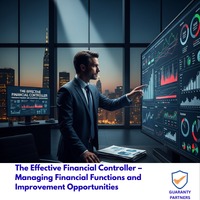
The Effective Financial Controller – Managing Financial Functions and Improvement Opportunities
Course Overview
• Understand the extent of change in the role of the Financial Controller and to focus on the areas of their organisation where change is required
• Use the information sources within their organisation to assist the management process
• Prepare for the introduction of advanced methods of information management
• Critically assess the planning process in their organisation
• Participate fully in strategic planning
• Understand the role of advanced budgeting and where it might fit into their organisation
• Integrate new developments in strategic management accounting, information management and support for decision making
• Implement methods of change management in their organization
Training Format:In-class, Virtual, In-house
Location:Lagos, Accra, Nairobi, Kigali
Language:English, French
Nigeria Price:
₦30000
Int'l., (Nigeria) Price:
$1000
Ghana Price:
$4000
Kenya Price:
$5500
Rwanda Price:
$6000
Nigeria Price:₦30000
Int'l., (Nigeria) Price:
$1000
Ghana Price:
$4000
Kenya Price:
$4000
Rwanda Price:
$4000
Nigeria Price: ₦30000
Int'l., (Nigeria) Price:
$1000
Ghana Price: $4000
Kenya Price: $4000
Rwanda Price: $4000
Introductions – The Controller’s Position
• The Controller’s status in the business
• Controllership functions
• Organisational relationships
• The controller’s role in management
• The changing nature of the controllership role: “Finance of the Future”
• Working capital and cash flow management
• Debtors
• Creditors
• Stocks/Inventory
• Releasing cash from the balance sheet
• Optimising cash balances
Cost and Management Accounting
• Introduction to Cost and Management Accounting
• Materials costs, Labour costs and Overhead costs
• Product cost determination
• Activity Based Costing (ABC)
• Activity Based Management (ABM)
• Product profitability and the cost of quality
• Theory of constraints
• Benchmarking
Planning, Forecasting and Budgeting
• Long term and short term planning
• Strategic planning with risk
• Budgeting and risk
• Traditional budgeting and Budgetary control
• Operational forecasting risk
• The Balanced Scorecard, Strategy Maps, Alignment
• Sources of competitive advantage
• Capital forecasting, capital budgeting and risk
Advanced Budgeting
• Objectives of Advanced Budgeting CAM-I and the Beyond
• Budgeting Round Table
• Target Cost Management
• Requirements
• Understanding target cost
• Implementation
• Value engineering
• Challenges
• Rewards
Management Decision Strategies
• Economic Value Added (EVA)
• Electronic Data Interchange
• Value Chain Analysis
• Total life cycle costing
• Managing in a time of change
• Enterprise Risk Management (ERM)
• Motivation
1ST BATCH: Tuesday, April 7, 2026 — Friday, April 10, 2026.
2ND BATCH: Tuesday, July 28, 2026 — Friday, July 31, 2026.
3RD BATCH: Tuesday, November 24, 2026 — Friday, November 27, 2026.
The training methodology integrates lectures, interactive discussions, collaborative group exercises, and
illustrative examples. Participants will acquire a blend of theoretical insights and hands-on practical
experience, emphasizing the application of learned techniques. This approach ensures that attendees return
to their professional environments equipped with both the competence and self-assurance to effectively
implement the acquired skills in their responsibilities.