
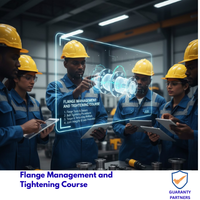
Flange Management and Tightening Course
Course Overview
• Understand features of a flange and types of flanges
• Appreciate the advantages and disadvantages of flanges in oil, gas and petroleum industry.
• Learn about types of gaskets used as sandwiched layer between flanges for sealing
• Appreciate the importance of bolts and nuts and materials of construction
• Understand concepts around torque and optimum torque, as applied to flange tightening
• Management around flange tightening
• Comprehend flange bolt-tightening procedure
• Study various serious incidents due to leaking flanges in gas and petroleum industry.
• Understand care of flanges and gaskets.
• Learn about some special tools and equipment used in flange tightening
• Note the causes of corrosion and failure in flanges
• Heed the instructions by package suppliers / vendors on tightening the flanges in their equipment/packages
• Learn about some specialized agencies who carry out specialised flange tightening
• Be aware of further advanced training and certification avenues available for Flange Management and Tightening Course
Training Format:In-class, Virtual, In-house
Location:Lagos, Accra, Nairobi, Kigali
Language:English, French
Nigeria Price:
₦350000
Int'l., (Nigeria) Price:
$1000
Ghana Price:
$4000
Kenya Price:
$5500
Rwanda Price:
$6000
Nigeria Price:₦350000
Int'l., (Nigeria) Price:
$1000
Ghana Price:
$4000
Kenya Price:
$4000
Rwanda Price:
$4000
Nigeria Price: ₦350000
Int'l., (Nigeria) Price:
$1000
Ghana Price: $4000
Kenya Price: $4000
Rwanda Price: $4000
Concepts
• Flange and types of flanges
• Materials of construction of flanges
• Advantages and disadvantages of flanges in oil, gas and petroleum industry
• Learn about types of gaskets and their materials of construction
• Appreciate the importance of bolts and nuts and their materials of construction
• Understand what a torque and optimum torque is as applied to flange tightening
Flange Management Requirement and Procedure
• Flange general requirements
• Bolting
• Thread lubricants and preservatives
• Flange Faces
• Requirements around gaskets for flange-joint integrity
• Insulation gasket sets and specialty gaskets
Tightening
• Tightening methods.
• Hot bolting and preventative bolting.
• Hot bolting requirements
Hot bolting procedure
• Instructions by package suppliers / vendors
• Insulation management for cryogenic and hot services flanges
Flange Opening
• Flange joints disturbance procedure
• Insulation removals from cryogenic and hot services flanges
• Breaking flange joints
• Making joints.
• Tagging procedure.
Maintenance Management
• Inspection & testing
• Causes of corrosion and failures in flanges
• Preventative maintenance bolting procedure
• Flange system records
• Understand care of flanges and gaskets.
• Responsibilities
Tools, Equipment and Manpower
• High-pressure High-force equipment including accessories
• Manual/ hand torque wrench
• Hand tools
• Manpower – Engineer, Supervisor, Safety man, Mechanic/helper
• Specialized agencies
• Precautions on storage of flanges, their tightening equipment and manpower
Serious Incidents During Flange Bolting and Unbolting
• Safety Precautions
• Study of incidents
• Analysis of problem areas around flanges, root cause analysis and corrective actions
• Presentation of solutions by the participants
Miscellaneous Knowledge
• Solving the associated case studies’ problems
• Specialized agencies who carry out flange bolting and unbolting
• Advanced training and certification avenues available for flange bolting and unbolting
• Reference Documentation
• Manufacturing codes and practices
• Other best practices
1ST BATCH: Tuesday, January 27, 2026 — Friday, January 30, 2026.
2ND BATCH: Tuesday, May 19, 2026 — Friday, May 22, 2026.
3RD BATCH: Tuesday, September 15, 2026 — Friday, September 18, 2026.
The training methodology integrates lectures, interactive discussions, collaborative group exercises, and
illustrative examples. Participants will acquire a blend of theoretical insights and hands-on practical
experience, emphasizing the application of learned techniques. This approach ensures that attendees return
to their professional environments equipped with both the competence and self-assurance to effectively
implement the acquired skills in their responsibilities.