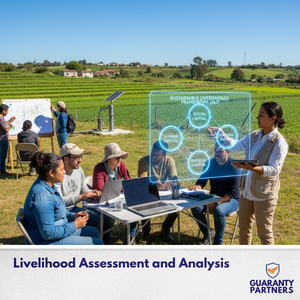
Livelihood Assessment and Analysis
Course Overview
By the end of this course, participants will be able to:
- Understand the concepts and frameworks of livelihood assessment and analysis.
- Identify and evaluate key livelihood assets, strategies, and outcomes.
- Conduct field-based livelihood assessments using qualitative and quantitative tools.
- Analyze the impact of external factors (e.g., policies, shocks, and trends) on livelihoods.
- Develop actionable recommendations for livelihood improvement and sustainability.
- Apply participatory approaches to engage communities in assessing and enhancing their livelihoods.
Training Format:In-class, Virtual, In-house
Location:Lagos, Accra, Nairobi, Kigali
Language:English, French
Nigeria Price:
₦350000
Int'l., (Nigeria) Price:
$1000
Ghana Price:
$4000
Kenya Price:
$5500
Rwanda Price:
$6000
Nigeria Price:₦350000
Int'l., (Nigeria) Price:
$1000
Ghana Price:
$4000
Kenya Price:
$4000
Rwanda Price:
$4000
Nigeria Price: ₦350000
Int'l., (Nigeria) Price:
$1000
Ghana Price: $4000
Kenya Price: $4000
Rwanda Price: $4000
Introduction to Livelihoods and Assessment Frameworks
- Definition and importance of livelihoods in development contexts.
- Overview of the Sustainable Livelihoods Framework (SLF).
- Components of the framework: Assets, Vulnerabilities, Strategies, and Outcomes.
- Integration of livelihoods into development planning and humanitarian response.
Livelihood Assets and Capital Analysis
- Identifying the five livelihood capitals:
- Human capital (skills, education, health).
- Natural capital (land, water, resources).
- Social capital (networks, relationships, institutions).
- Physical capital (infrastructure, equipment).
- Financial capital (income, savings, credit).
- Tools for assessing and mapping livelihood assets.
Vulnerability Context and External Influences
- Understanding the vulnerability context:
- Shocks (e.g., natural disasters, conflicts).
- Trends (e.g., economic, technological, demographic).
- Seasonal variations.
- Analyzing the role of policies, institutions, and processes in shaping livelihoods.
Livelihood Strategies and Outcomes
- Identifying livelihood strategies adopted by individuals and communities.
- Evaluating livelihood outcomes: income, well-being, food security, and resilience.
- Trade-offs and choices in livelihood strategies.
Participatory Livelihood Assessment Tools
- Participatory rural appraisal (PRA) techniques.
- Focus group discussions and key informant interviews.
- Household surveys and asset mapping.
- Using technology for data collection: mobile apps, GIS, and remote sensing.
Data Analysis and Interpretation
- Quantitative and qualitative data analysis techniques.
- Developing livelihood profiles and trends.
- Identifying gaps, opportunities, and areas for intervention.
1ST BATCH: Tuesday, February 24, 2026 — Friday, February 27, 2026.
2ND BATCH: Tuesday, June 16, 2026 — Friday, June 19, 2026.
3RD BATCH: Tuesday, October 13, 2026 — Friday, October 16, 2026.
The training methodology integrates lectures, interactive discussions, collaborative group exercises, and
illustrative examples. Participants will acquire a blend of theoretical insights and hands-on practical
experience, emphasizing the application of learned techniques. This approach ensures that attendees return
to their professional environments equipped with both the competence and self-assurance to effectively
implement the acquired skills in their responsibilities.